


Vacation ownership has a habit of sounding far more complicated than it needs to.
You start with a fairly simple idea, taking regular vacations, and five minutes later you’re hearing about points, booking windows, resort networks, annual fees and exchange programs.
So let’s strip away the jargon.
At its simplest, vacation ownership means buying into a travel system that you can use for future stays. Exactly what you own and how you use it depends on the program.
Some forms of timeshare are connected to a particular property or period of use, while newer vacation clubs may use points that can be spent across different destinations, dates and accommodation types.
And that difference matters.
There isn’t one set of rules that applies to every vacation club. Before deciding whether vacation ownership makes sense for you, you need to understand the system you’re actually considering—not the general idea of timeshare ownership.
Here’s what that looks like in practice.
First things first: Points aren’t the same as nights
If you’ve never used a points-based vacation club before, this is probably the easiest place to get confused.
Say you’re given a certain number of points each year. It can be tempting to mentally convert them into nights:
“Okay, so how many nights does that get me?”
There usually isn’t one answer.
Think of your points more like a vacation budget. How far they stretch depends on what you choose to book.
A two-bedroom suite during Christmas week in a popular resort destination might require considerably more points than a studio during a quieter travel period. Destination, season, accommodation size and length of stay can all affect the number of points required.
It’s really not that different from booking hotels with money.
A $1,000 hotel budget might cover several nights in one destination and barely a weekend in another. The amount hasn’t changed, the cost of what you’re booking has.
Points work in much the same way.
That’s why the more useful question isn’t simply:
How many points do I get?
It’s:
What kinds of trips can I realistically take with those points?
If you’re curious about how that can translate into actual vacations, have a look at these spring break destinations you can book with timeshare points, including places such as Orlando, Myrtle Beach and Las Vegas.
Seeing real destinations makes the concept a lot easier to understand than staring at a points balance on paper.
A bigger resort network isn’t always a better one

Vacation clubs understandably like talking about the size of their resort networks.
Hundreds of destinations! Dozens of resorts! So many possibilities!
Great! But would you actually go to them?
That’s the question that matters.
Imagine you’re a family that takes a beach vacation almost every year, likes resort pools, prefers having a kitchen and usually travels for a week at a time. A network full of family-friendly resort destinations could be genuinely useful.
Now imagine you’re a solo traveler who likes changing countries every few days, staying in independent guesthouses and deciding where to sleep after arriving in town.
The same vacation club suddenly looks very different.
It’s not about whether the network is objectively “good.” It’s whether it fits your style of travel.
Accommodation matters just as much as destination.
Some vacation ownership properties offer more space than a standard hotel room, with separate bedrooms, living areas and kitchen facilities. Club Wyndham, for example, offers these kinds of layouts at applicable properties within its resort network.
That can make a big difference on longer trips.
You can make breakfast instead of finding a restaurant every morning. Kids can go to bed without forcing everyone else into darkness at 8 p.m. Someone can take a nap while everyone else carries on with the day.
For longer stays, those everyday conveniences can matter more than a fancy lobby.
And vacation clubs aren’t your only option if space and flexibility are priorities. It’s worth comparing them with vacation rental platforms for 2026, especially if you regularly book apartments, villas or entire homes.
The goal isn’t to decide that one accommodation type is always better.
It’s to figure out which one works for the trip you’re actually taking.
Flexible Booking Still Requires Some Planning
One of the major differences between points-based vacation clubs and traditional fixed-week timeshares is flexibility.
Instead of automatically returning to the same property during the same week every year, points may allow you to choose among different resorts, dates and accommodation sizes.
That sounds wonderfully flexible—and it can be.
But flexible doesn’t mean:
“I’ll decide on Friday afternoon that I want a two-bedroom suite somewhere popular for Saturday.”
Availability still exists.
There are only so many rooms at any property, and you’re not the only person trying to book them.
School holidays, Christmas, spring break and other popular travel periods naturally attract more demand. Larger suites may also have more limited availability than smaller units.
So before buying into any vacation ownership program, learn how its reservations actually work.
- How early can you book?
- Do different resorts have different booking windows?
- How many points are typically needed for the dates you prefer?
- What happens if you don’t use all your points?
- Can unused points be carried forward?
- And if you’re someone who loves booking trips at the last minute, how realistic is that within the system?
This is where knowing yourself as a traveler becomes surprisingly important.
If your usual planning style is:
“Should we go somewhere this weekend?”
then a vacation model that works best with reservations made months ahead may frustrate you, no matter how attractive the resorts look.
Flexibility isn’t about having no rules.
It’s about having rules that work with the way you travel.
Don’t ignore the long-term part

When people consider vacation ownership, they’re usually picturing the vacations.
Understandably.
Nobody sits through a presentation dreaming about future ownership paperwork. But this is a long-term decision, and long-term decisions need a second question: What happens if my life looks completely different several years from now? Maybe your children grow up and you no longer need a two-bedroom suite.
Maybe you start traveling less.
Maybe your preferred destinations change.
Perhaps work, finances, family responsibilities or health affect how often you can get away.
That’s why it’s worth understanding resale, transfer and exit options before they become urgent.
Club Wyndham offers trusted timeshare exit consultations through the company’s Certified Exit program. Depending on the owner’s individual circumstances and eligibility, specialists may discuss possibilities such as resale guidance, transferring ownership to an immediate family member and other ways of managing an ownership.
There is no charge to speak with a Certified Exit Specialist, although specific solutions can have their own costs or eligibility requirements. The important thing to remember is that there isn’t one universal exit process that applies to every vacation owner.
Your contract matters. Your program matters. Your circumstances matter.
So if your travel habits eventually change, the best starting point is usually the official owner resources associated with your vacation ownership program.
And yes, you need to talk about maintenance fees
Now for the part that’s considerably less fun than choosing between a beach resort and a mountain getaway.
Maintenance fees.
Vacation ownership can involve annual maintenance fees and other recurring charges, and they need to be included when you’re deciding whether the overall arrangement makes financial sense.
The Federal Trade Commission advises prospective timeshare buyers to look beyond the original purchase price and consider ongoing expenses such as maintenance fees, taxes and travel costs. Annual maintenance fees may also increase over time.
That’s one of the biggest differences between vacation ownership and simply booking accommodation when you need it.
With a hotel, the relationship is fairly simple.
You choose a room, pay for the stay, check out and move on.
Vacation rentals may come with cleaning or service fees, but they’re still generally tied to that individual booking.
Vacation ownership creates a longer-term financial commitment.
That doesn’t automatically make it expensive or poor value. It simply means you need to compare the full cost with the way you actually travel.
Here’s an easy exercise.
Look back at your last three years of vacations. Where did you go?
How often did you travel? How long did you usually stay?
Did you normally book hotel rooms, apartments or resorts?
Did you need a kitchen? How much space did you use?
How far in advance did you plan?
Now compare those habits with the vacation ownership program you’re considering. This is much more useful than imagining the traveler you might become after buying it. You know the version.
Next year you’re apparently going to take five vacations, wake up early every morning, use every resort amenity and never have a scheduling conflict again.
Maybe.
But base the decision on your real travel habits first.
Be careful with unsolicited “Exit” offers
There’s another reason understanding your official exit options matters.
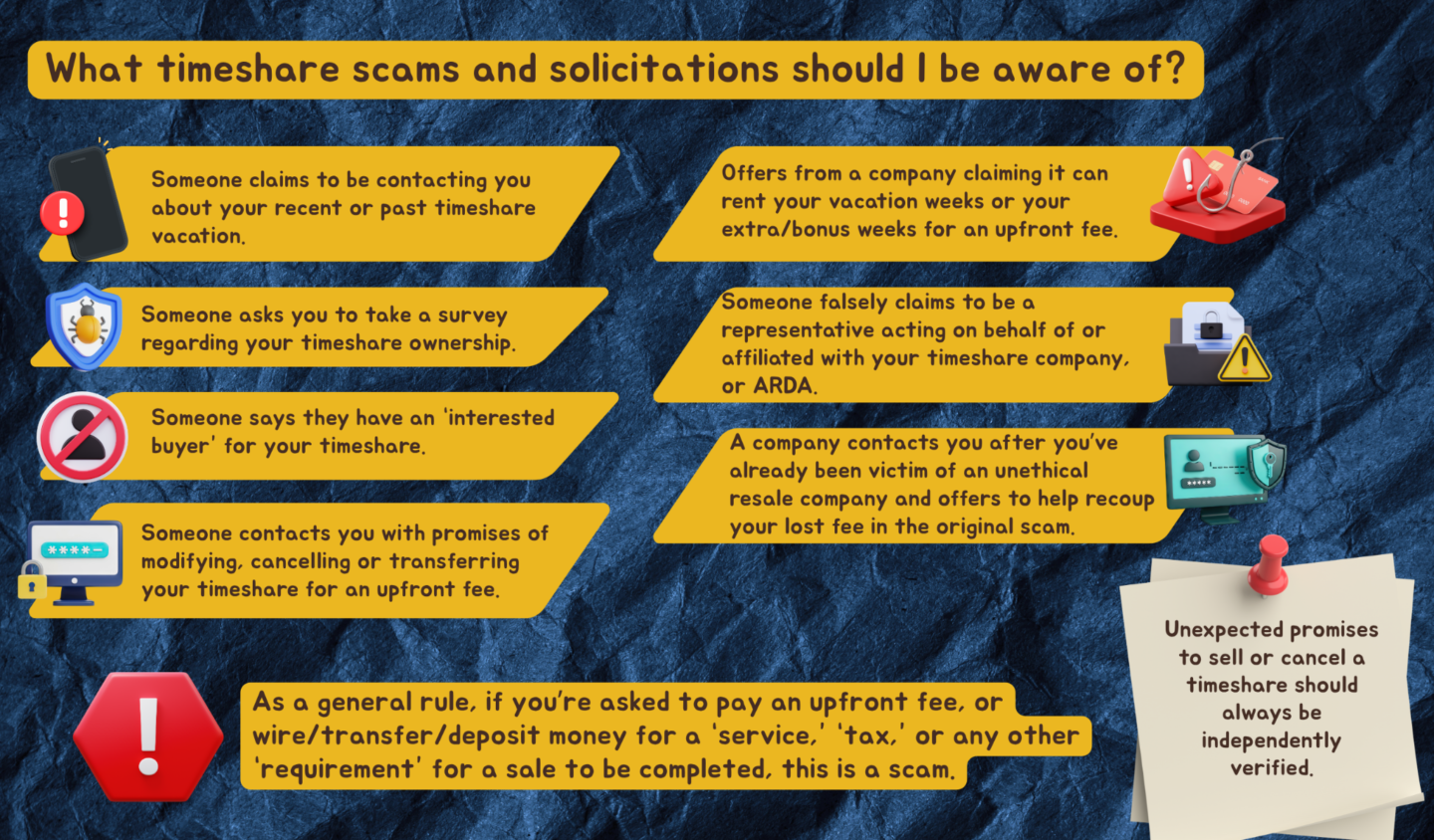
Timeshare resale and exit scams exist.
Owners may receive unsolicited calls or messages from companies claiming they have a buyer ready, can guarantee cancellation or can quickly get them out of their ownership.
That’s where caution is essential.
The FTC warns consumers about tactics including demands for large upfront payments, guaranteed outcomes and advice telling owners to stop making mortgage or maintenance-fee payments.
If someone contacts you unexpectedly with an amazing solution, don’t let urgency make the decision for you.
Verify the company independently. Read agreements carefully. Understand exactly what you’re paying for.
And be particularly cautious if someone promises a guaranteed result without thoroughly reviewing your ownership documents. A caller knowing specific details about your timeshare doesn’t automatically prove they’re legitimate either.
When in doubt, start with the vacation ownership company’s official resources before bringing a third party into the situation.
So, who does points-based vacation ownership suit?
There isn’t one type of traveler who should, or shouldn’t, buy vacation ownership.
But there are some travel habits that tend to fit the model better than others.
It may make sense if you vacation regularly, enjoy resort-style stays, like having extra living space and are comfortable planning some trips in advance.
It may be less appealing if you travel infrequently, prefer extremely spontaneous trips or spend most of your holidays in places that aren’t well represented within the resort network.
And remember: owning vacation club points doesn’t mean you have to use them for every single trip.
Travel doesn’t need that kind of commitment. You might use your vacation ownership for a week-long family resort stay, then book a boutique hotel for a city break and rent a cabin for your next hiking trip.
You can mix things up.
If you’re comparing options for trips around the US, these vacation rental sites that cover destinations across the USA are another useful place to see what alternatives are available.
The point isn’t to squeeze every trip into one accommodation category.
It’s to use the option that makes the most sense each time.
The five questions I’d ask before buying

If all the terminology still feels like a lot, bring it back to five questions.
1. What exactly am I buying?
Find out whether you’re purchasing deeded ownership, a right-to-use arrangement, points or another type of vacation-club product.
2. What can I realistically book?
Look beyond the brochure. Check actual destinations, typical point requirements, accommodation sizes and the travel periods you personally use.
3. How does availability work?
A long resort list is only valuable if you can realistically book the properties and dates that interest you.
4. What will this cost over time?
Include the purchase cost, annual maintenance fees and any other applicable ongoing or transaction charges.
5. What happens if my circumstances change?
Understand the official options for transferring, reselling or exiting the ownership before you ever need them.
And that’s really the heart of it.
Modern vacation ownership can offer considerably more choice than the old stereotype of spending the same week at the same resort every year. But more choice also means more things to understand. So don’t buy because a resort pool looks irresistible.
Don’t buy because someone tells you how many destinations are available. And definitely don’t buy based on the vacations you hope you’ll start taking someday.
Look at how the points actually work, what you’ll pay, where you genuinely travel and how far ahead you normally plan.
Then ask yourself the question that matters most:
Would I actually use this?
If the answer is yes, and you understand exactly what you’re signing up for, then you’ll have a much clearer idea of whether vacation ownership belongs in your travel plans.
This article provides general consumer and travel information only. It is not legal or financial advice.