

The Real Reason Your Fashion Ads Are Underperforming
Fashion brands live and die by visual storytelling. A compelling product video can drive a shopper from casual scroll to completed purchase in under thirty seconds — but producing that video has traditionally required a photographer, a videographer, a model, a location, and a post-production team.
For independent fashion labels, emerging DTC brands, and e-commerce sellers managing tight margins, that production overhead is simply not sustainable at the volume modern advertising demands. You need fresh creative for every campaign, every season, every A/B test — and the traditional production model cannot keep up.
Why Traditional Fashion Video Production Is Holding You Back
The fashion industry moves faster than any production schedule can accommodate. Trend cycles that once lasted a season now shift weekly, driven by social media and influencer culture. By the time a traditionally produced campaign clears concept approval, casting, shooting, and editing, the trend it was designed to capture has already peaked.

This is where Pollo AI changes the equation. As a comprehensive AI video generator, Pollo AI integrates over a hundred AI video tools into a single platform, enabling fashion marketers to convert product images, lookbook photography, and written creative briefs into high-quality video content within minutes.
The platform covers text-to-video, image-to-video, and reference-based video generation, with AI avatar capabilities that produce natural expressions and emotional nuance — all without a film crew or editing suite. For fashion e-commerce teams running continuous campaign cycles, this kind of on-demand production capacity is not just convenient. It is a structural competitive advantage.
Lookbook content that previously required a full-day shoot can be generated from existing product imagery. Campaign variations for A/B testing — different color treatments, different model aesthetics, different emotional tones — can be produced in parallel rather than sequentially. Seasonal refreshes that would have required a reshoot can be generated from the same source assets with updated styling direction. The creative possibilities expand significantly when production time is measured in minutes rather than days.
Step-by-Step: Building a Fashion Ad Video From Scratch
Step 1 — Define Your Campaign Objective and Visual Identity
Every effective fashion video starts with a clear brief. Before opening any platform, define the specific product or collection being featured, the target customer and their context, the emotional tone you want to communicate, and the platform or placement where the video will run. This brief becomes the foundation of every prompt and creative decision that follows.
Your visual identity — the color palette, mood, lighting style, and aesthetic that define your brand — needs to be translated into language that AI generation tools can interpret accurately. Terms drawn from fashion photography and cinematography give the system precise creative parameters. “Soft, diffused natural light with a warm neutral palette” communicates something very specific. “Clean studio aesthetic with high-key lighting and minimal shadow” communicates something equally specific but very different.
Step 2 — Prepare Your Source Assets
Gather the product images, lookbook photography, or reference visuals you want to work from. High-resolution images with clear subject definition and strong compositional structure produce the best results in image-to-video workflows. If you are generating from text rather than existing imagery, invest time in writing detailed product descriptions that capture the texture, drape, color, and character of the garment.

Pollo AI’s AI video generator supports reference-based video generation that maintains character and scene consistency across frames — a critical capability for fashion content where the coherence of styling, fit, and product detail across a video sequence directly affects how the product reads to a potential buyer.
Step 3 — Generate Your Core Content
Submit your creative brief and source assets to the platform and generate your initial output. For fashion content specifically, pay close attention to how the garment moves, how the color reads on screen, and whether the overall aesthetic aligns with your brand positioning. Motion quality matters enormously in fashion video — fabric drape, natural movement, and the way a garment responds to the body all communicate quality signals that static images cannot convey.
Step 4 — Generate Variations for Testing
One of the most significant practical advantages of AI video generation for fashion marketers is the ability to produce multiple creative variations quickly. Generate versions with different visual treatments — warmer versus cooler color grading, more editorial versus more commercial aesthetics, different motion approaches — and use them to run structured A/B tests across your ad placements.
Step 5 — Adapt for Platform-Specific Requirements
Export your content in the formats and aspect ratios appropriate for each platform where you plan to run it. Instagram Stories, TikTok, Pinterest, and paid social placements each have different technical specifications and audience expectations. Generating platform-specific versions from the outset — rather than cropping a single master file — consistently produces better results.
Scaling Fashion Content With AI: What the Numbers Look Like
Consider a mid-sized fashion e-commerce brand running campaigns across Instagram, TikTok, and Pinterest simultaneously. Traditional production for a single seasonal campaign — covering three platforms, two product lines, and a minimum of three creative variations per placement — might require five to eight days of production and post-production time, plus the associated labor costs. The same campaign scope, executed through AI video generation with a well-developed prompt library and clear visual identity documentation, can be produced in a fraction of that time.
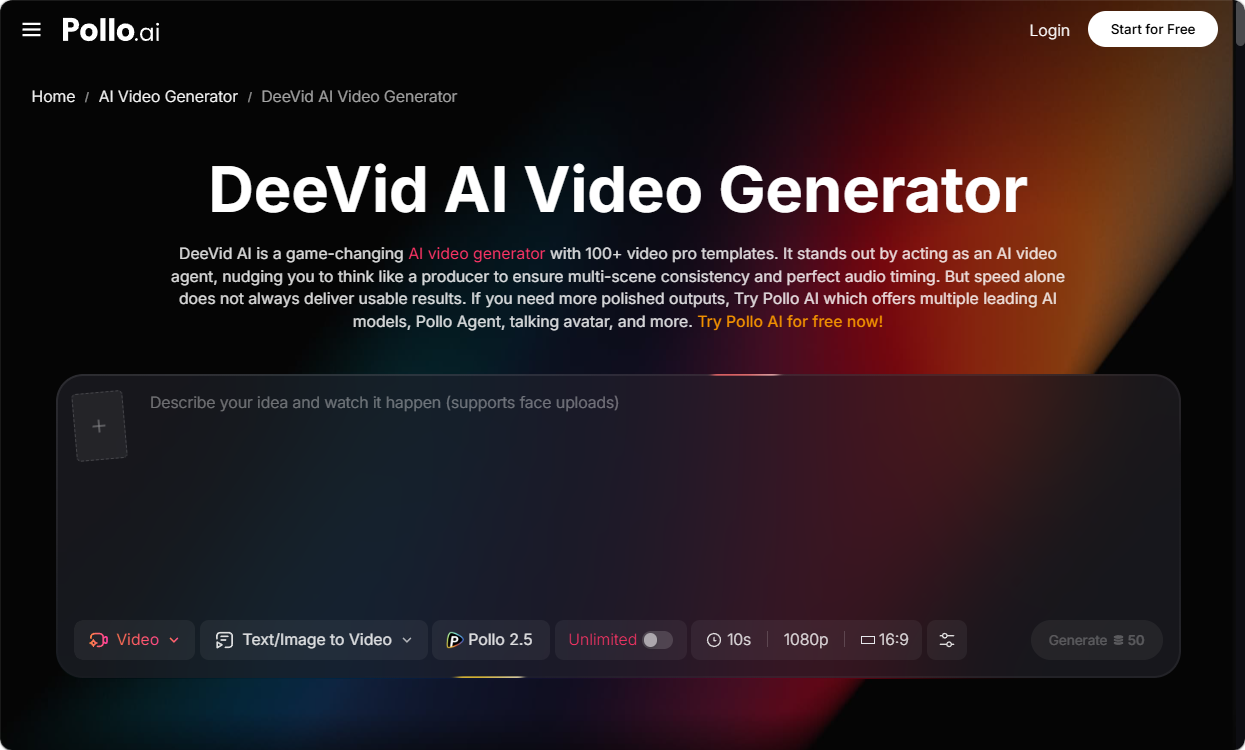
DeeVid AI extends this capability further with a producer-guided workflow built around over a hundred professional templates, making it particularly effective for fashion brands that need to maintain consistent style and character appearance across multi-segment video content. Its integrated text-to-speech and AI music capabilities mean that a complete, publication-ready fashion ad — visuals, voiceover, and soundtrack — can be produced within a single workflow. For brands running large-scale social advertising with continuous creative refresh requirements, DeeVid AI’s capacity to produce campaign content at scale and support A/B testing across variations represents a meaningful operational advantage.
Advanced Techniques for Fashion-Specific AI Video
Consistency across a campaign is one of the more nuanced challenges in AI-generated fashion content. When producing a series of videos for a single collection, maintaining visual coherence — consistent color treatment, consistent model aesthetic, consistent environmental context — is essential for brand recognition. Developing a set of standardized prompt templates that encode your campaign’s visual identity and applying them consistently across all generations is the most effective way to achieve this at scale.
Audio is an often-overlooked dimension of fashion video performance. The right soundtrack communicates brand positioning as powerfully as the visual content. Platforms that integrate AI music generation with video output — automatically matching audio to the visual mood and pacing of the clip — remove a significant friction point from the production process and ensure audio-visual coherence without manual curation.
Common Mistakes Fashion Marketers Make With AI Video
Treating AI generation as a one-shot process is the most common and most costly mistake. The first generation is a starting point, not a finished product. Build iteration into your workflow — generate multiple outputs, evaluate each against your campaign brief, and refine your prompt approach based on what is and is not working.
Neglecting the product detail dimension is a fashion-specific pitfall. Generic AI video prompts produce generic-looking output that fails to communicate the specific quality signals — material texture, construction quality, fit and drape — that convert fashion shoppers. Every prompt should include specific language about the product’s key visual characteristics.
Ignoring platform-native content norms is another frequent misstep. Fashion content that performs on Pinterest has different visual characteristics than fashion content that performs on TikTok. Generate platform-specific content from the outset rather than adapting a single master version.
Conclusion: Fashion Content at the Speed of Trend
The production barrier that has historically limited fashion video marketing to brands with significant budgets and production resources is no longer a structural reality. AI video generation has made it possible to produce high-quality fashion ad content on demand — at the pace of trend cycles, across every platform simultaneously, and with the creative variation that effective performance marketing requires.
Start with your best product imagery, define your brand’s visual identity in prompt language, and generate your first campaign variation. The creative capacity you have been working around is now within reach.