

There was a time when travelling for sport was pretty straightforward.
You bought a ticket, booked a hotel somewhere near the stadium, watched the game and headed home.
For plenty of fans, that’s no longer enough.
A game can now be the excuse for an entire weekend away. Travellers are adding extra nights, exploring the city, trying local restaurants, booking activities and choosing hotels and resorts where there is actually something to do once the final whistle blows.
Sports travel is slowly becoming less about getting to a game and more about everything you can build around it.
The game is just one part of the trip
Think about how you would plan a trip to see your favourite team play in another city.
You could fly in Saturday morning, watch the game and leave Sunday. Or you could arrive on Friday, spend a couple of days exploring, find the places where local fans hang out, make a night of the game and leave with a much better feel for the city.
More travellers are choosing the second option.
The same idea works across different sports. A golf tournament can turn into a few days on the course. A Formula 1 weekend can become a city break. A football match can be paired with food, nightlife and sightseeing. A marathon might be the main reason for booking the flight, but the destination often determines how long you stay.
Sports events give people a reason to travel. What happens around the event is increasingly shaping the holiday.
Fans want more than a seat in the stadium
Watching sport is only part of what makes travelling for it fun.
There is the walk to the stadium with thousands of other supporters. The bar everyone visits before the game. The local food you try because somebody in the queue recommended it. The neighbourhoods you discover because you decided to stay an extra day.
These experiences can end up being just as memorable as the event itself.
It is also why sports tourism isn’t limited to huge international tournaments anymore. Travellers are planning trips around college football weekends, golf tournaments, running events, cycling races and local sporting traditions.
You don’t necessarily have to be following the biggest event on the calendar. Sometimes experiencing how another city or country celebrates a sport is the attraction.
Where you stay is becoming part of the experience
Accommodation used to be one of the simpler parts of planning a sports trip.
Find somewhere reasonably priced, make sure it isn’t too far from the venue and book it.
But once a trip stretches beyond a single night, the hotel or resort starts playing a bigger role.
Travelling with friends might mean looking for somewhere with good social spaces and places to watch other games. Families may want pools, activities and larger accommodation. If you’re turning a sporting event into a longer vacation, fitness facilities, restaurants and entertainment can suddenly become much more important than simply being within walking distance of the stadium.
Some hospitality brands are beginning to rethink what a stay built around sport can actually look like, and Sports Illustrated Resorts is one of the more interesting names entering this space.
The concept brings together two well-established worlds.
Sports Illustrated has spent more than 70 years documenting the athletes, teams, rivalries and moments that shape sports culture, while Travel + Leisure Co. brings decades of experience in vacation ownership and resort hospitality. Sports Illustrated Resorts takes that sporting legacy beyond the page and turns it into something fans can experience as part of a trip in a vacation club for sports fans.
Rather than simply offering a hotel close to a stadium, the idea is to make sport part of the stay itself. Properties are being developed in destinations with strong sports and entertainment cultures, with accommodation, fitness, dining, social spaces and fan experiences designed around the way people increasingly travel for sport.
The concept is already moving from idea to physical destinations. Sports Illustrated Resorts Nashville opened to guests in September 2026 following a full renovation of its 185-suite Music Row property, while a purpose-built resort is under development in Tuscaloosa, home of the University of Alabama. Chicago is also part of the brand’s growing footprint.
It offers a good example of where sports tourism could be heading: a trip where watching the game is still a highlight, but the sporting experience doesn’t begin and end at the stadium.
Sports trips aren’t just for Die-Hard Fans
One of the best things about this shift is that you don’t necessarily need everyone in your group to care about the same sport.
We’ve probably all travelled with someone whose idea of a perfect Saturday is very different from ours.
One person wants to spend the afternoon at the game. Someone else would rather explore the city. The kids want a pool. Another person is already researching restaurants.
A destination-led sports trip can accommodate all of them.
Instead of asking everyone to spend an entire weekend focused on one event, the game becomes one part of a larger itinerary. It makes sports travel much easier for couples, families and groups where only some people are serious fans.
Resorts are particularly well placed for this type of trip because different travellers can do different things without having to plan completely separate vacations.
You don’t have to be watching sport either
Sports travel isn’t only about spectators.
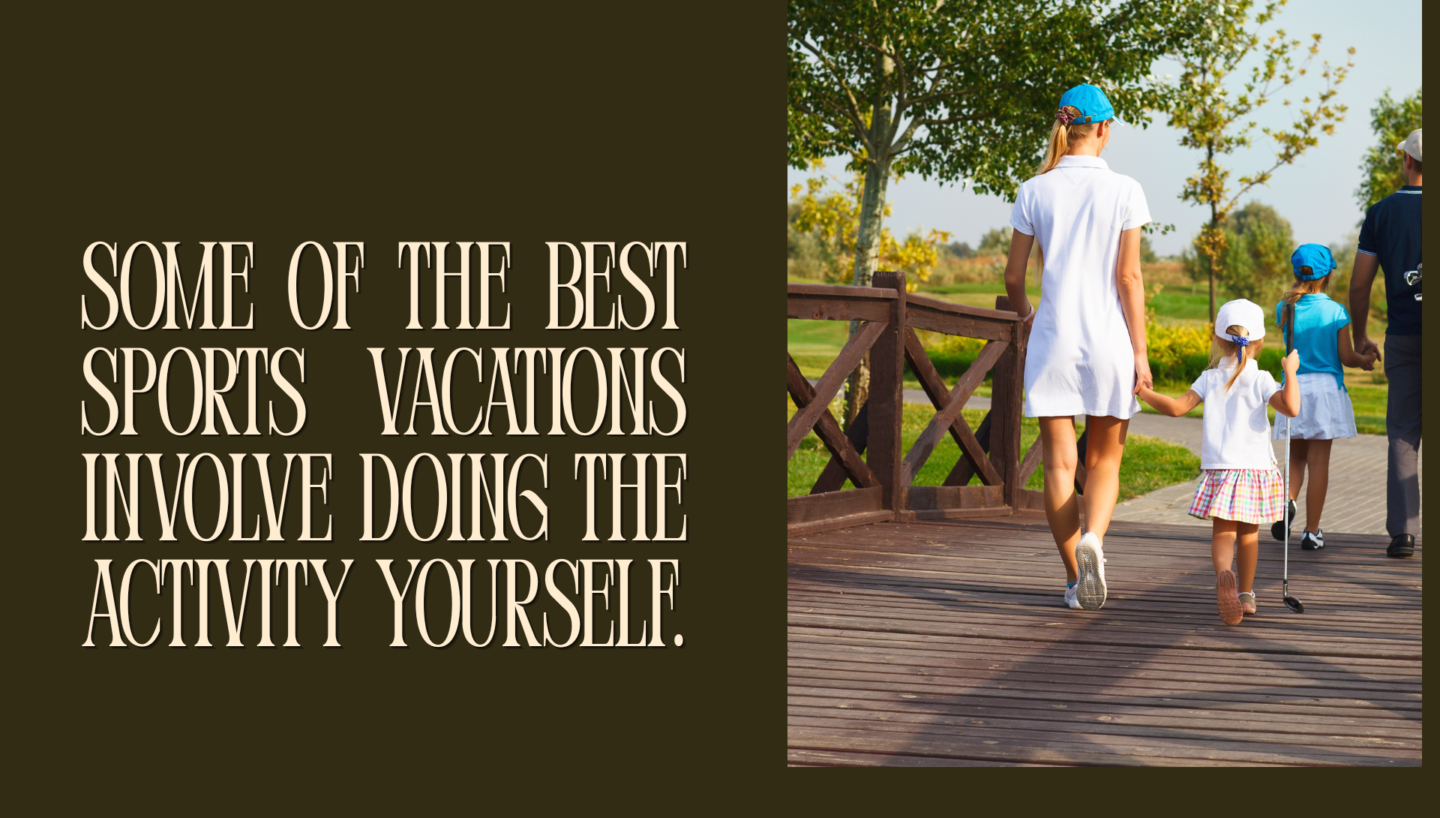
Golf weekends have been popular for years, but the category now stretches much further. Travellers are booking running trips, cycling holidays, ski vacations, tennis weekends, hiking adventures and fitness-focused escapes.
Sometimes there isn’t even a professional sporting event involved.
You might choose a destination because of its golf courses. You might travel somewhere because you’ve always wanted to run a marathon. Or perhaps you want a resort where you can spend the morning being active and the afternoon beside the pool.
This is where the line between an active vacation and a sports vacation starts to disappear.
The destination still makes the trip
A great stadium can convince you to visit somewhere once. A great destination gives you reasons to stay longer.
Cities with strong sporting identities have an obvious advantage here.
Chicago, for example, isn’t simply somewhere to watch baseball or basketball. You can spend days exploring its neighbourhoods, food scene, architecture and lakefront. Nashville may draw sports fans for football or hockey, but music, nightlife and Southern food can easily fill the rest of the weekend.
This is also why sports-focused hospitality concepts have room to grow in destinations like these.
Sports Illustrated Resorts has been developing properties in locations including Chicago and Nashville, where sport already sits alongside a much broader tourism experience. Guests can build their trip around a game without making the entire vacation dependent on it.
That combination is likely to appeal to travellers who want the energy of a sports weekend while still having everything else they expect from a getaway.
Sport can be a brilliant way to experience a place
There is something different about visiting a destination when thousands of people are excited about the same thing.
Go to a city during an important game and you’ll see a side of it that isn’t always visible on a normal sightseeing trip.
Restaurants fill up. Jerseys appear everywhere. Strangers start conversations. Entire neighbourhoods seem to move towards the stadium at the same time.
You get a glimpse of what people care about locally.
And you don’t necessarily need to understand every rule of the sport to enjoy it.
For travellers who like experiencing destinations through food, music, festivals and local traditions, sport can offer another way into the culture of a place.
Turning game day into a getaway
The game will probably always be the reason many sports fans start planning their trip.
But it doesn’t have to be the only reason the trip is worth taking.
Stay another night.
Explore the city. Eat somewhere local. Try the sport yourself.
Choose accommodation where you actually want to spend time rather than somewhere you’re simply using to sleep. Because sometimes the best sports trips aren’t only about what happened during the game.
They’re about everything you did before and after it.