

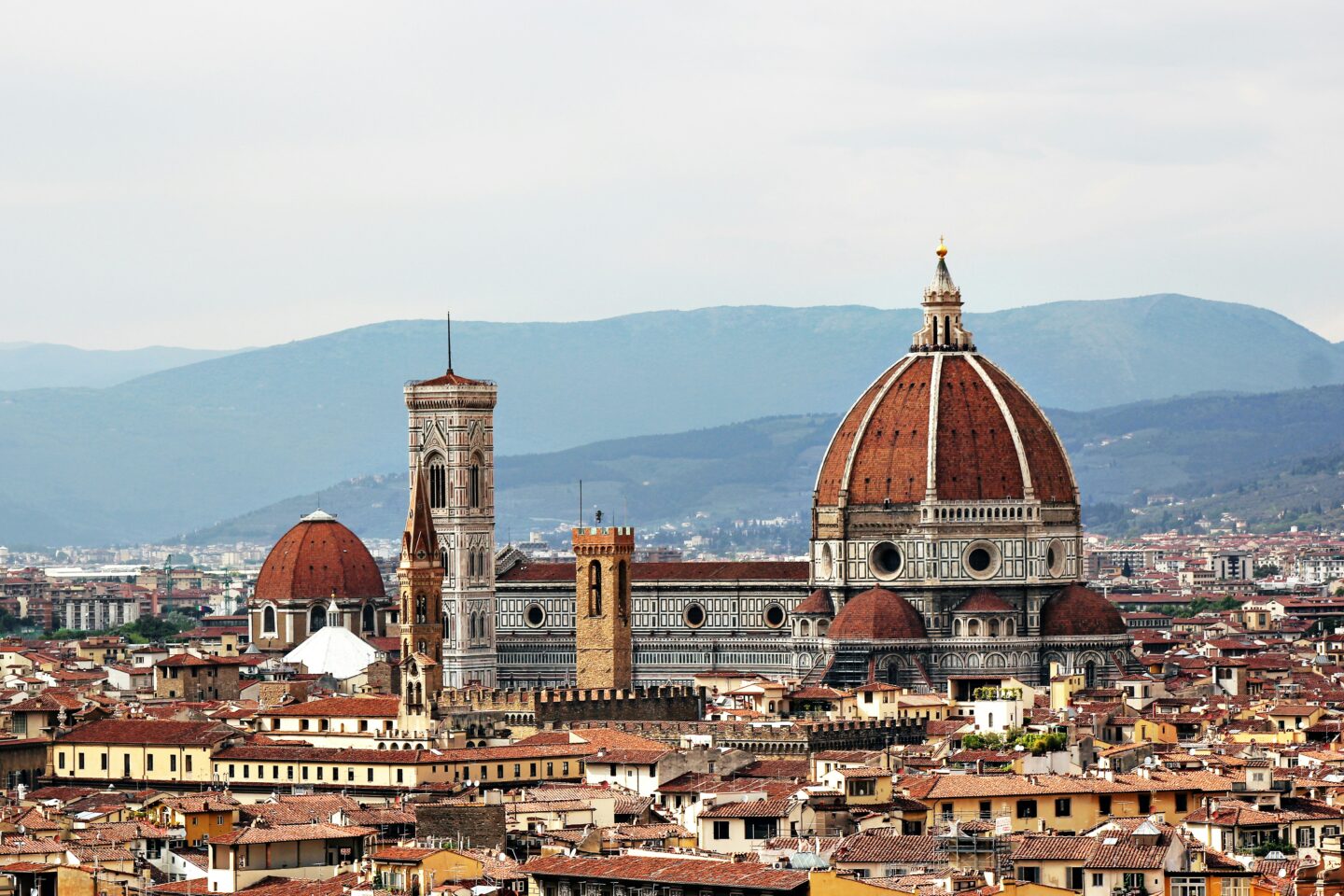
Florence is often introduced through its greatest names: Michelangelo, Botticelli, Brunelleschi, Donatello. Visitors arrive with museum reservations, church tickets, and a mental checklist of masterpieces. That version of the city is worth seeing, but it can make Florence feel distant, as if its beauty belongs only behind ropes, frames, and glass.
The more intimate version of Florence is found in its surfaces. Stone steps worn smooth by centuries of feet. Leather hanging in warm, earthy rows behind a workshop window. Gold leaf catching the light inside a quiet frame-maker’s studio. Marble dust resting on the floor like flour. Paint, pigment, paper, metal, wax, wood, and fabric all tell their own version of the city’s story.
To experience Florence well, look at it as a place of materials rather than monuments. Its art was carved, stretched, mixed, stitched, hammered, polished, restored, and handled. That handmade spirit remains one of the clearest ways to understand the city today.
Start With the Materials, Not the Monuments
A first visit to Florence can easily revolve around the Uffizi, the Accademia, the Duomo, and the Ponte Vecchio. These are important stops, but they can push travelers into a rushed rhythm where the city becomes a list of famous rooms.
A better approach is to ask what Florence is made of. Look at the stone under your feet, the carved doorways, the frames around paintings, the leather bindings in shop windows, the marbled paper, the frescoed ceilings, and the metalwork on old balconies. The city begins to feel more like a working studio than a static display.
This is where guided context can help, especially for travelers who want to connect the city’s Renaissance legacy with its living creative traditions. Experiences focused on Florence art and artisan tours can make it easier to understand how galleries, neighborhoods, studios, and historic craft techniques fit into the same story.
Many of the skills that shaped Florence are still visible in small workshops, family-run studios, and artisan streets where handwork continues beside the tourist crowds.
Marble Dust and the Memory of Sculpture
Marble is easy to overlook in Florence because it appears everywhere: church façades, sculptures, floors, tombs, columns, fountains, and staircases. The city’s famous works can feel so polished and permanent that the physical effort behind them disappears.
But marble begins as resistance. It has to be cut, struck, sanded, and coaxed into shape. When you think about the dust, tools, noise, and labor behind a sculpture, the statues become evidence of patience, risk, and muscle.
The Accademia’s unfinished works make this process especially clear. Michelangelo’s figures seem to struggle out of the stone, leaving the act of making visible. Outside the museums, that same awareness changes how you move through the city. A carved doorway becomes a record of tools. A church floor shows centuries of use. A weathered statue in a piazza reveals the long relationship between material, maker, and time.
Instead of moving quickly from one landmark to the next, pause near the details. Look at the folds in stone clothing, the veins in marble columns, the chips in older surfaces, and the repairs that keep them standing. Florence rewards close looking.
Gold Leaf, Frames, and the Quiet Work of Preservation
Gold appears throughout Florence in altarpieces, frames, religious panels, ceiling details, and decorative interiors. It can seem effortless, but gold leaf is one of the city’s most delicate forms of craftsmanship. It requires a steady hand, a patient eye, and a respect for fragility.
Gilding is easy to miss because it often supports the artwork people came to see. A visitor may focus on a painting without noticing the frame that shapes the viewing experience. They may admire a chapel without thinking about the restoration skills that protect its surfaces.
Behind many finished masterpieces are woodworkers, gilders, restorers, framers, painters, and conservators. Their work affects how art survives and how visitors encounter it. In Florence, preservation is part of the city’s creative identity.
A useful way to notice this craft is to look at edges: frames, borders, carved panels, painted ceilings, and decorative corners. These details often reveal the skill that holds the larger image together.
Leather, Paper, and the Oltrarno’s Handmade Rhythm
Crossing the Arno changes the mood of Florence. The Oltrarno, especially around Santo Spirito and San Frediano, offers a more grounded view of the city’s artisan life. Leatherworkers, paper makers, bookbinders, jewelers, restorers, and small studios sit between cafés, homes, and everyday neighborhood scenes.
Leather is one of the most visible crafts in Florence, though quality varies widely. The best experiences come from learning how to look closely. Smell the material. Notice the stitching. Ask where something was made. Look for signs of hand-finishing rather than mass production.
Paper offers another entry into the city’s handmade culture. Marbled paper, journals, bindings, and stationery connect Florence to a slower form of travel. Watching a sheet of marbled paper take shape can be as memorable as viewing a famous painting because the process becomes part of the experience.
The city’s official tourism resources highlight Florence’s artisan workshops as an important part of its cultural identity, especially in neighborhoods where traditional skills remain visible. For travelers, these workshops offer a way to stay close to Florence’s artistic roots without spending every hour in crowded museum corridors.
Paint, Pigment, and the Colors Hidden in Plain Sight
Florence has a subtle palette at first glance: stone façades, terracotta rooftops, soft river light, and pale church interiors. Then color appears suddenly in a frescoed chapel, a painted ceiling, a decorated manuscript, a row of pigments in a shop, or a restored panel glowing in a dim room.
Pigment connects Florence’s grand artistic history to everyday observation. Renaissance painters depended on materials that had to be ground, mixed, layered, and handled with care. Color came from minerals, plants, earth, trade routes, and workshop knowledge before it became an image.
A fresco shows this relationship clearly. It depends on plaster, timing, moisture, pigment, and skill. The painter had to work while the wall surface was still receptive, which gives many frescoes a sense of urgency even centuries later.
Bring this awareness into churches, cloisters, palaces, and small museums. Look for fading, restoration marks, color transitions, and painted architectural illusions. Some of Florence’s most moving details are fixed directly into walls and ceilings.
How to Build a Hands-On Florence Itinerary
A Florence itinerary built around craft does not need to skip the major sights. It needs breathing room. Choose one major museum or church for the day, then balance it with a neighborhood walk, a workshop visit, and time to observe details without rushing.
A strong day might begin with a Renaissance masterpiece, continue with lunch near Santo Spirito, then move through artisan streets in the Oltrarno. Add a paper shop, a leather studio, or a restoration-focused stop. Finish with a slow walk back across the river when the light softens over the façades and bridges.
This approach works well for travelers planning a wider route through Tuscany or beyond. Florence can become a slower cultural pause in the middle of travelling around Italy, especially for visitors who want their itinerary to include local texture rather than only famous landmarks.
Build contrast into the day. Pair a polished gallery with a dusty studio. Pair a famous sculpture with raw stone. Pair a grand church with a small shop where someone is cutting, painting, binding, or stitching by hand. Leave space for wandering, since some of Florence’s best artisan moments appear through open doors and quiet streets.
What to Look For When Choosing Artisan Experiences
Because Florence is so popular, its handmade reputation is often used as a selling point. A beautiful storefront does not always mean the work is local, and a crowded market stall does not always tell the full story of the craft.
Look for transparency. Good artisan experiences explain materials, methods, and history. They help travelers understand why a process matters, not just what the finished object costs. A meaningful visit should sharpen your eye whether you buy something or leave empty-handed.
Smaller groups often work better for this kind of travel because they allow space for questions and observation. Florence’s creative side is best understood at a human scale, with enough time to notice tools, gestures, and details.
Think beyond souvenirs. The goal is not simply to collect leather goods, paper, jewelry, or prints. The deeper value is learning how Florence has used skilled hands to shape beauty across centuries. With that knowledge, even a simple doorway or shop window becomes more interesting.
The City That Still Works by Hand
Florence becomes more personal when experienced through its materials. Marble, gold leaf, leather, paper, pigment, and paint bring the city down from the pedestal and back into the hands of the people who shaped it.
This kind of travel asks for patience. It asks you to look at edges, textures, tools, and surfaces. It invites you to cross the river, step away from the busiest rooms, and notice the work still happening in small studios and quiet streets.
The reward is a Florence that feels less distant. Instead of only admiring the city, you begin to understand how it was made. You see the dust behind the sculpture, the hand behind the frame, the stitch behind the leather, and the pigment behind the glow. That is the Florence you can touch.